Description
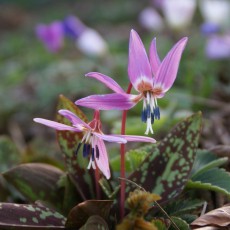
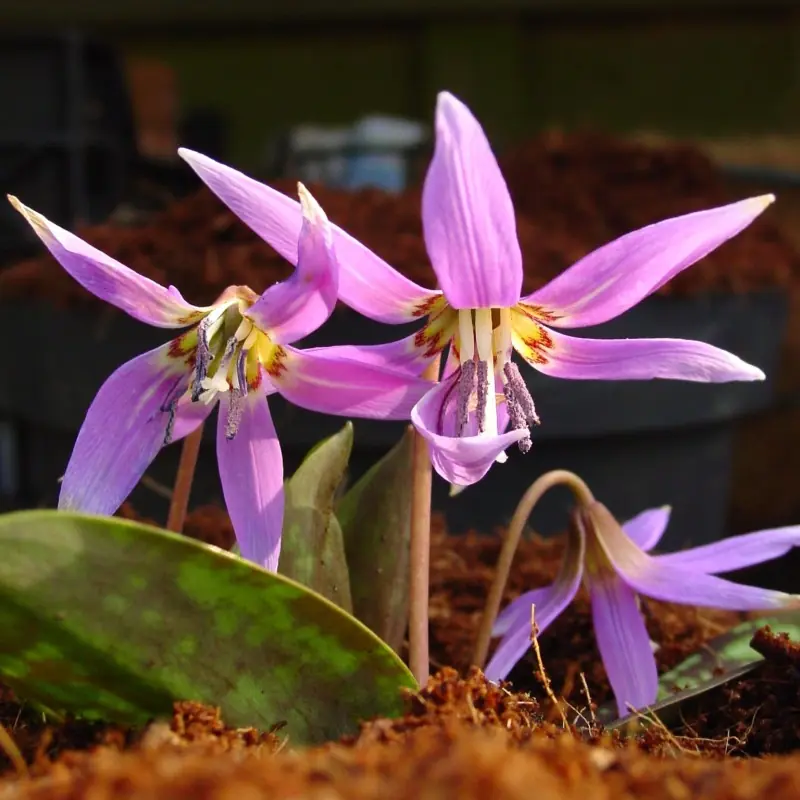
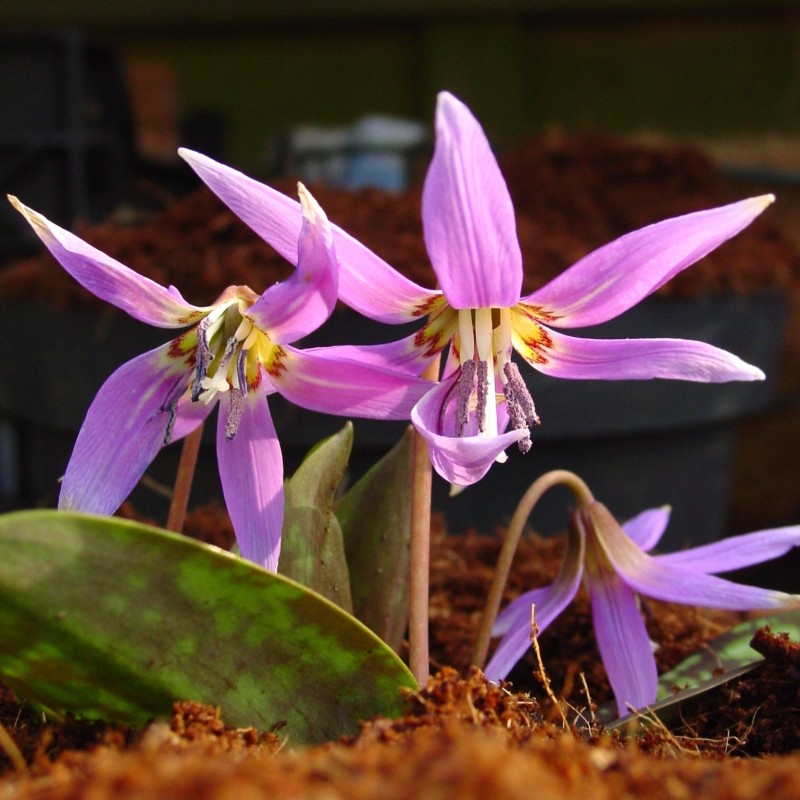
Cultivated since 1596. Common names are dogs-tooth or dog's tooth violet, but is also called serpent's tongue, trout lily, deer tongue. Gorgeous marbled leaves. If planted (as undergrowth) in a nutrient-rich, not too dry soil, they can replicate fast - after a somewhat slow start. Available are the wild form and some beautiful selections.
BELONGS TO THE FAMILY OF LILIACEAE
The genus Erythronium has been cultivated for many centuries. Its distribution area is extensive: Central and Southern Europe, Iran, and the Caucasus, and many species originate in North America. The name dog's tooth is derived from the fused tubular tuber, comparable to a dog's tooth. The leaves are opposite, broadly oval-shaped, and always two per plant.
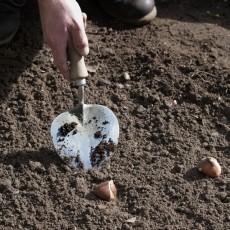
Almost all Erythronium species have beautifully patterned foliage. A striking detail is that, except for many species with nodding flowers, the tips of the petals are bent backwards as flowering progresses. The plants prefer somewhat sandy, humus-rich soil in a shaded spot, and the tubers should be planted quite deep. They can remain in the same place for many years and propagate mainly by seed. Erythronium tubers are very sensitive to wind and can therefore dry out quickly after being dug up. Mechanical harvesting is not conducive to quality; damage to the tuber quickly leads to mold formation, resulting in a difficult crop.